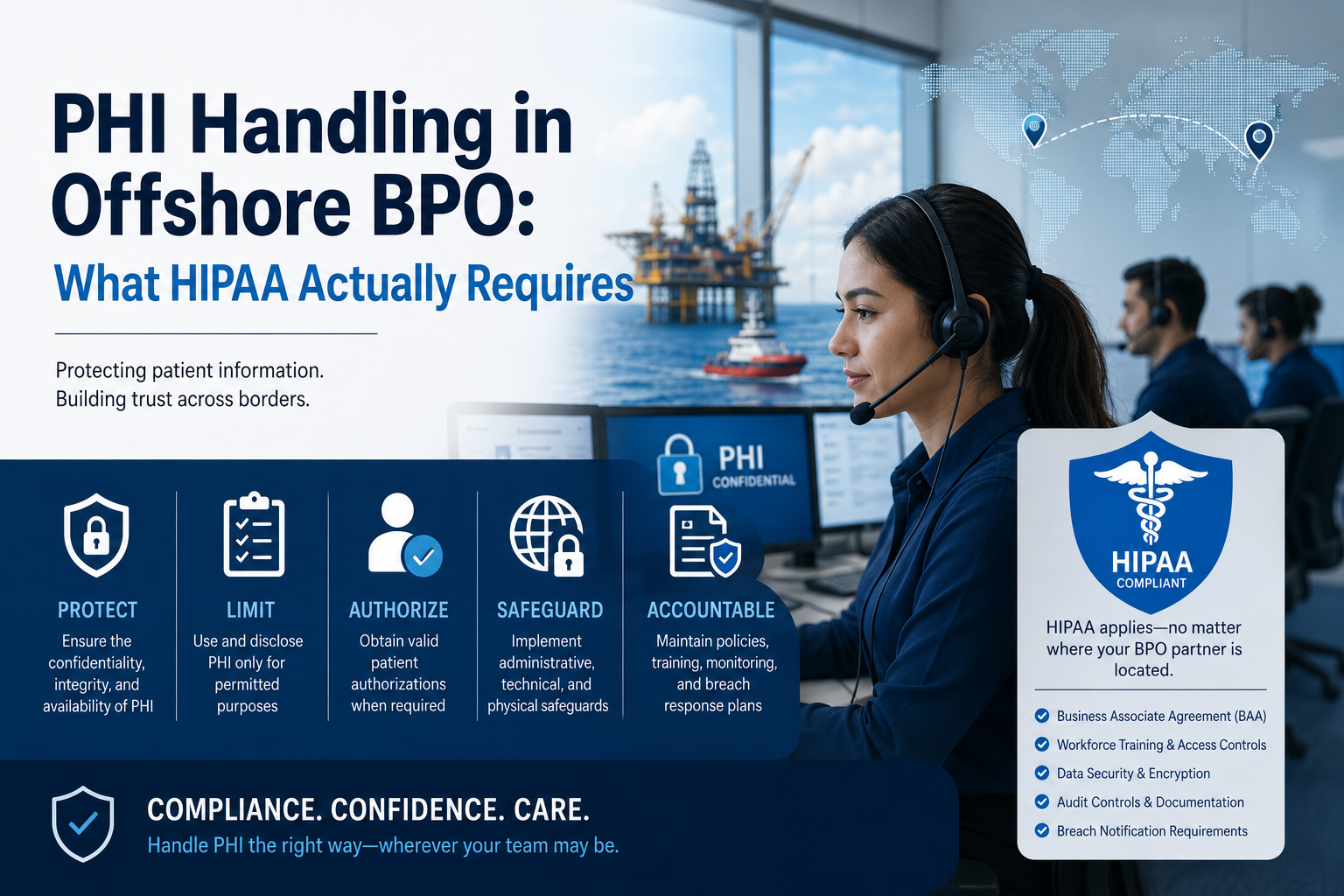
Quick Answer: Any offshore BPO that creates, receives, maintains, or transmits PHI becomes a HIPAA business associate the moment it touches patient data – geography is irrelevant. HIPAA compliance requires a signed Business Associate Agreement (BAA) with an offshore-specific addendum, plus three operational layers: access architecture, physical environment controls, and agent-level PHI discipline enforced through HIPAA-specific QA scorecards.
Business associates are now implicated in more than one in three healthcare data breaches in the United States, according to the HIPAA Journal’s 2025 Healthcare Data Breach Report. The largest single breach of 2025 – 62 million Americans’ protected health information compromised at Conduent Business Services – was a business associate incident. When a US healthcare organisation outsources patient support, benefits verification, or claims administration to an offshore BPO, the offshore provider becomes a business associate the moment it touches PHI. Everything that follows from that legal designation – the BAA, the security architecture, the QA process, the audit rights – is not optional. This article explains exactly what it requires.
What Makes an Offshore BPO a HIPAA Business Associate?
An offshore BPO becomes a HIPAA business associate the moment it creates, receives, maintains, or transmits PHI on behalf of a covered entity – regardless of which country it operates in. A signed Business Associate Agreement is legally required before a single patient record is accessed.
Under HIPAA’s Privacy and Security Rules, a business associate is any person or entity that creates, receives, maintains, or transmits protected health information on behalf of a covered entity. The designation is functional, not contractual: the moment your offshore BPO accesses a patient record, views a billing statement, or handles a call in which PHI is discussed, it is operating as a business associate regardless of what the contract says.
Healthcare functions that create business associate status for an offshore BPO:
- Patient scheduling (if patient identity and appointment type are recorded)
- Benefits verification and eligibility checking (patient name, date of birth, insurance ID, diagnosis codes)
- Claims administration and submission (patient demographics, procedure codes, diagnosis codes, charges)
- Revenue cycle management support (billing history, payment records, AR follow-up calls)
- Patient support calls (any call in which a patient’s identity and healthcare matter are discussed together)
The practical implication: if you are outsourcing any of these functions to South Africa or any other offshore destination, your BPO partner is a business associate under HIPAA and must execute a compliant Business Associate Agreement before operations begin. There is no carve-out for offshore processing. The HIPAA Privacy Rule applies to how PHI is handled regardless of geography; the Security Rule sets the floor for how electronic PHI (ePHI) must be protected, also regardless of geography.
Related reading: See which healthcare BPO functions Afrishore delivers from South Africa and how roles are structured: Healthcare BPO Roles in South Africa. For the full HIPAA-compliant service architecture: Afrishore HIPAA-Compliant BPO.
What Must an Offshore BAA Actually Include?
A standard BAA covers permitted uses, safeguards, breach notification, and subcontractor flow-downs – but an offshore BAA requires three additional provisions: geographic processing disclosure, data localisation terms, and subcontractor mapping with flow-down BAAs for the South African supply chain.
A standard BAA between a US covered entity and an offshore BPO partner must include all the provisions required by the HIPAA Omnibus Rule. An offshore context requires additional specificity in three areas that standard domestic BAA templates typically leave vague.
Standard BAA provisions (required regardless of geography):
- Permitted uses and disclosures of PHI
- Prohibition on uses not authorised by the covered entity
- Appropriate safeguards requirement (administrative, physical, technical)
- Reporting obligations for security incidents and breaches
- Subcontractor flow-down requirements (any subcontractor with PHI access must also execute a BAA)
- Return or destruction of PHI at contract termination
- Government access and cooperation requirements
Offshore-specific addendum provisions:
- Geographic processing disclosure: Explicit statement of which countries PHI may be processed in. Some payer contracts and state laws restrict offshore PHI processing – the BAA must flag this upfront rather than discovering a conflict post-launch.
- Data localisation requirements: If the covered entity or its payers require PHI to remain on US soil (even for processing), the BAA must specify what infrastructure is used and how South African teams access it remotely without creating offshore copies.
- Subcontractor mapping: For a South African BPO, this means documenting which South African subcontractors (facility security contractors, IT support, HR platforms) may interact with PHI and ensuring flow-down BAAs cover them.
- Annual verification attestation: Under the proposed HIPAA Security Rule NPRM published 6 January 2025, business associates will be required to verify – at least annually – that they have deployed the technical safeguards required by the Security Rule. Offshore BAAs should pre-emptively include this clause rather than waiting for the final rule (expected summer 2026).
2026 HIPAA Security Rule Update: The January 2025 NPRM proposes the most significant modifications to the HIPAA Security Rule since 2003. Key changes affecting offshore BPOs include mandatory annual technical safeguard attestations, 72-hour breach notification (versus the current 60-day standard), and enhanced requirements for contingency planning and data recovery. Offshore BPO partners who cannot demonstrate readiness against the proposed changes should not be awarded contracts that will extend into the post-rule environment.
How Does PHI Handling Actually Work in an Offshore BPO?
Secure PHI handling in an offshore BPO operates across three layers: a locked-down access architecture (role-based access, encryption, audit logging), a controlled physical environment (biometric entry, no personal devices, clean-desk), and agent-level PHI discipline enforced through a HIPAA-specific QA scorecard on every reviewed call.
A BAA is a legal instrument. What actually determines PHI security is what happens on the floor – the daily operational decisions about how agents access, handle, and close PHI in the course of their work. Secure PHI handling in an offshore BPO environment requires all of the following.
Access Architecture
| Access Layer | Requirement | Implementation |
| Workstation access | Role-based, individual-level | Biometric or MFA login; no shared credentials |
| EHR / system access | Minimum necessary | Access profiles set per role; no access beyond job function |
| PHI in transit | Encrypted | TLS 1.2+ for all data transmission; VPN or secure tunnel for remote EHR access |
| PHI at rest | Encrypted | AES-256 for stored data; no PHI on portable media |
| Audit trail | Logged | System-level access logs; reviewed quarterly at minimum |
| Screen recording / monitoring | Selective | Call recording governance; no unauthorised screen capture |
Physical Environment
Offshore PHI handling requires physical controls that match or exceed standard US facility requirements:
- No personal mobile devices in the operations area
- No USB, external storage, or portable media at workstations
- Clean-desk enforcement: no paper PHI left unattended
- Camera-monitored floor with footage retained per contractual requirements
- Biometric or access-card-controlled entry to the PHI-handling floor
- Visitor sign-in with escorted access only (relevant for site audits)
- 24/7 on-site security personnel
Agent-Level PHI Discipline
Physical and technical controls are necessary but not sufficient. The third layer is agent behaviour: whether individual agents, in the normal course of their work, handle PHI correctly when no one is watching. This is where compliance culture matters – the same principle that applies to general BPO compliance applies with higher stakes in a healthcare context.
Specific agent behaviours that constitute PHI mishandling (and must be caught in QA):
- Reading PHI fields that are not necessary for the task at hand
- Repeating PHI (patient name, DOB, diagnosis) in an audible environment without confirming the caller is the authorised individual
- Leaving a PHI-containing screen visible when stepping away from the workstation
- Discussing a patient case with a colleague without minimum-necessary discipline
- Retaining notes about a patient beyond the session in which the call occurred
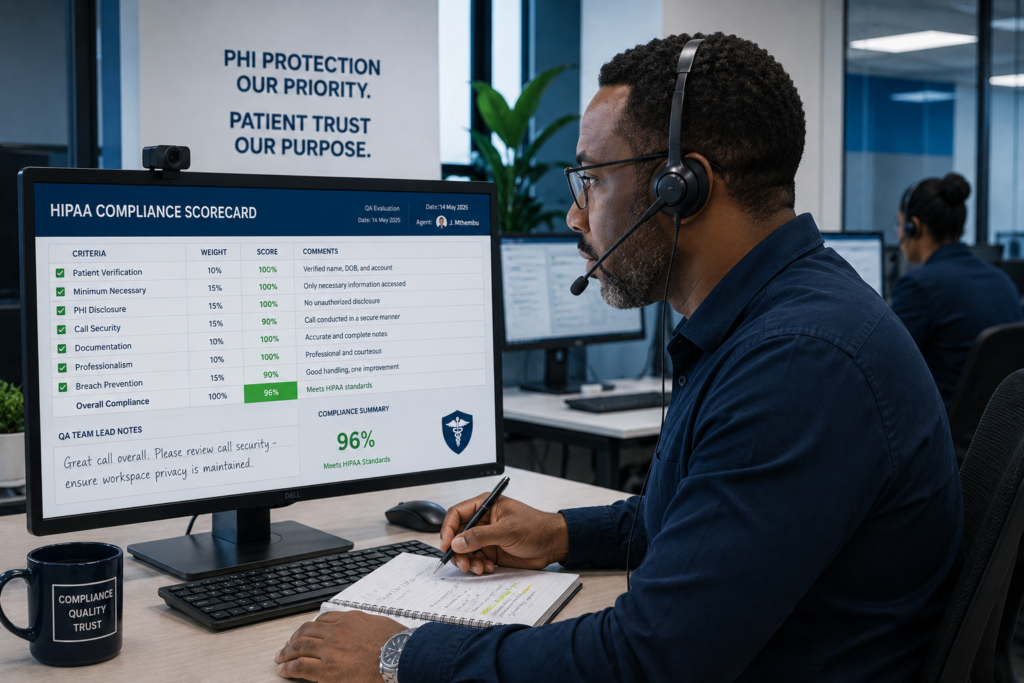
QA scorecards for HIPAA compliance should specifically audit for these behaviours on every reviewed call, not just for task completion and communication quality.
How Should a Healthcare BPO QA Scorecard Handle HIPAA Compliance?
HIPAA QA must be a separate, parallel evaluation layer to general service quality – not the same scorecard. It evaluates identity verification, minimum-necessary access discipline, PHI environment discipline, and escalation protocol compliance, with agents scoring below 85% removed from PHI-handling work.
A healthcare BPO QA scorecard has two layers: service quality (the standard contact centre metrics) and HIPAA compliance (a separate, parallel evaluation). The HIPAA QA layer should be non-negotiable and must be documented separately from general quality scores.
HIPAA QA scorecard elements:
| Element | Score | Pass Criteria |
| Identity verification before PHI disclosure | /20 | Verified caller identity using at least two confirming factors before discussing PHI |
| Minimum necessary access | /20 | Accessed only PHI fields required for the task; no browse or curiosity access |
| PHI in environment discipline | /15 | No PHI visible or audible to unauthorised parties; clean-screen on step-away |
| Call recording and documentation | /15 | Call recorded per policy; notes limited to task-relevant information |
| Escalation protocol compliance | /15 | Appropriate escalation when task exceeded agent’s PHI access authorisation |
| Breach awareness response | /15 | Correctly identified and reported a potential PHI incident (tested scenario) |
Agents with HIPAA QA scores below 85% should be placed on a compliance performance plan before continuing PHI-handling work. Any agent involved in a confirmed PHI incident should be suspended from PHI access pending root cause review.
What Security Stack Does an Offshore Healthcare BPO Need?
The minimum security stack for offshore healthcare PHI handling includes: dedicated healthcare VLAN, endpoint MDR, MFA on all system access, DLP policies, SIEM with 6-year log retention, monthly vulnerability scanning, and SOC 2 Type II or HITRUST assurance – all disclosable to clients as part of BAA compliance documentation.
Beyond the agent-level controls, a South African BPO handling healthcare PHI requires a documented security stack that can be disclosed to clients and referenced in BAA compliance attestations.
Minimum security stack for healthcare BPO:
- Network security: Dedicated VLAN for healthcare workloads, separated from general BPO operations. Firewall rules preventing PHI data from reaching non-approved destinations. Intrusion detection/prevention system (IDS/IPS) monitoring.
- Endpoint protection: Managed detection and response (MDR) on all healthcare workstations. Automatic screen lock after 60-second inactivity. Encrypted hard drives (BitLocker or equivalent).
- Identity management: Multi-factor authentication for all system access. Privileged access management (PAM) for admin accounts. Access reviews quarterly.
- Data loss prevention: DLP policies blocking PHI from email, messaging, or file transfer channels not approved in the BAA. Email encryption for any client-approved PHI communication.
- Logging and SIEM: Security Information and Event Management (SIEM) system collecting logs from workstations, network devices, and application layers. Logs retained minimum 6 years per HIPAA requirements.
- Vulnerability management: Monthly vulnerability scans. Patch deployment within 30 days for critical vulnerabilities.
- Third-party assurance: SOC 2 Type II audit (or HITRUST r2 for healthcare-specific assurance – the most rigorous, covering 70+ regulations including HIPAA, NIST, and ISO 27001). Reports available to clients under NDA as part of BAA compliance documentation.
Can De-Identifying PHI Reduce Offshore HIPAA Compliance Complexity?
Yes, but only for analytics and back-office data workloads – not for patient-facing operations. Benefits verification, scheduling, and patient support require identifying the patient by definition, making de-identification operationally infeasible for these functions. A properly structured BAA remains the correct path.
One approach to reducing offshore HIPAA compliance complexity is processing de-identified data rather than PHI. Under HIPAA’s Safe Harbour de-identification method, 18 specific identifiers must be removed (patient name, DOB, geographic data below state level, dates, phone numbers, email, SSN, health plan numbers, account numbers, certificate/licence numbers, VINs, device identifiers, URLs, IP addresses, biometric identifiers, full-face photographs, and any other unique identifier). Data from which all 18 have been removed is no longer PHI and is not subject to HIPAA’s Privacy or Security Rules.
For certain offshore functions – analytics, pattern analysis, denial management root cause work, training data preparation – de-identification is a practical path to reducing BAA complexity. For front-line patient interaction (scheduling, support, verification), de-identification is not operationally feasible because the interaction requires identifying the patient.
For most healthcare BPO functions, the correct path is not de-identification but a properly structured BAA with a compliant offshore PHI handling architecture. De-identification is a supplement for analytics workloads, not a substitute for compliance in patient-facing operations.
Related reading: Afrishore’s HIPAA-aligned service structure is described on the HIPAA-Compliant BPO service page. For the broader context of offshore compliance standards in South Africa, see Why Outsource to South Africa.
Key Takeaways
- Business associates – including offshore BPO partners – are implicated in more than one in three US healthcare data breaches. The largest 2025 breach (Conduent, 62 million records) was a business associate incident.
- Any offshore BPO that creates, receives, maintains, or transmits PHI is a business associate by law, regardless of geography. A signed BAA is required before operations begin.
- Offshore BAAs require additional specificity: geographic processing disclosure, data localisation terms, subcontractor mapping, and (ahead of the final rule) annual technical safeguard verification clauses.
- PHI security in an offshore BPO requires three layers: access architecture (technical controls), physical environment controls, and agent-level PHI discipline (verified through HIPAA-specific QA scorecards).
- The minimum security stack for a healthcare BPO includes: dedicated healthcare VLAN, endpoint MDR, MFA, DLP policies, SIEM with 6-year log retention, monthly vulnerability scanning, and SOC 2 Type II or HITRUST assurance.
- The proposed 2026 HIPAA Security Rule updates include 72-hour breach notification requirements and mandatory annual technical safeguard attestations for business associates. Offshore BPO contracts should pre-emptively include these obligations.
Frequently Asked Questions
What is PHI (Protected Health Information) and when does an offshore BPO handle it?
Protected Health Information (PHI) is individually identifiable health information – any data that can be used to identify a person and relates to their past, present, or future health condition, healthcare provision, or healthcare payment. PHI includes names, dates, contact information, Social Security numbers, account numbers, health plan numbers, and any combination of data that could identify a patient. An offshore BPO handles PHI in healthcare functions including patient support calls (where the patient’s identity and health matter are discussed), benefits verification (patient identity + insurance + diagnosis codes), claims administration (patient demographics + procedure codes + billing data), and RCM support (billing history + AR records).
Does HIPAA apply to offshore BPO providers in South Africa?
HIPAA does not have direct extraterritorial jurisdiction, but it applies to the covered entity – your US healthcare organisation. When you contract with a South African BPO to handle PHI, you are responsible for ensuring the BPO implements HIPAA-equivalent safeguards. The mechanism is the Business Associate Agreement: a legally binding contract that requires the offshore BPO to implement administrative, physical, and technical safeguards, report breaches, and comply with HIPAA’s requirements as a condition of the relationship. A HIPAA violation by your BPO that stems from your failure to have a compliant BAA in place exposes you – the covered entity – to regulatory and civil liability.
What must a Business Associate Agreement cover for an offshore healthcare BPO?
A compliant BAA for an offshore BPO must cover all standard HIPAA provisions: permitted uses and disclosures, safeguard requirements, breach notification obligations, subcontractor flow-down requirements, and return or destruction of PHI at termination. Offshore BAAs additionally need: geographic processing disclosure (which countries PHI may be processed in), data localisation terms if required by payers or state law, subcontractor mapping with flow-down BAAs, and (ahead of the proposed rule) annual technical safeguard verification obligations.
What is the HIPAA Security Rule NPRM and how does it affect offshore BPOs?
On 6 January 2025, the Department of Health and Human Services published a Notice of Proposed Rulemaking (NPRM) proposing the most significant modifications to the HIPAA Security Rule since 2003. Key provisions affecting offshore BPOs include: a requirement for business associates to annually verify they have deployed the required technical safeguards; a 72-hour breach notification deadline (replacing the current 60-day standard for reporting to HHS); enhanced contingency planning requirements; and strengthened documentation and audit trail obligations. A final rule is expected in summer 2026. Offshore BPO contracts starting now should include these obligations proactively.
How do you verify that an offshore BPO is genuinely HIPAA-compliant?
Request the following: a signed BAA with the offshore-specific addendum provisions described above; the most recent SOC 2 Type II report (or HITRUST assessment for healthcare-specific assurance); evidence of annual security training completion for all agents handling PHI; access control documentation showing role-based access with audit logs; a breach response procedure and evidence it has been tested; and the results of the most recent vulnerability scan and patch status. During a site visit, ask to see: the physical security setup (biometric access, clean-desk enforcement, no personal devices), a workstation demonstration showing the access control architecture, and a call review from the HIPAA QA scorecard process. Do not accept self-attestation alone.
What happens if an offshore BPO causes a HIPAA breach?
If your offshore BPO causes a breach of PHI, you – the covered entity – must follow HIPAA’s breach notification requirements: notify affected individuals within 60 days (72 hours under the proposed rule), notify HHS, and for breaches affecting 500+ individuals in a state, notify prominent media in that state. If the breach results from the BPO’s failure to implement safeguards required by the BAA, you have contractual recourse against the BPO under the BAA terms. The BPO itself may also face direct liability under HIPAA’s enforcement framework since the Omnibus Rule extended direct liability to business associates via the HITECH Act. OCR civil monetary penalties can reach USD 2,190,294 per violation category per year (OCR, 2026 adjusted figure per inflation methodology).
Can PHI be de-identified to reduce offshore HIPAA compliance complexity?
Yes, for certain functions. Under HIPAA’s Safe Harbour method, removing 18 specific identifiers produces de-identified data that is not subject to HIPAA’s Privacy or Security Rules. De-identification is practical for analytics, denial management root cause analysis, and training data preparation. It is not operationally feasible for patient-facing functions (scheduling, support, verification) where identifying the patient is inherent to the task. The correct approach for most healthcare BPO functions is a properly structured BAA with a compliant PHI handling architecture, with de-identification reserved for analytics and back-office data workloads.