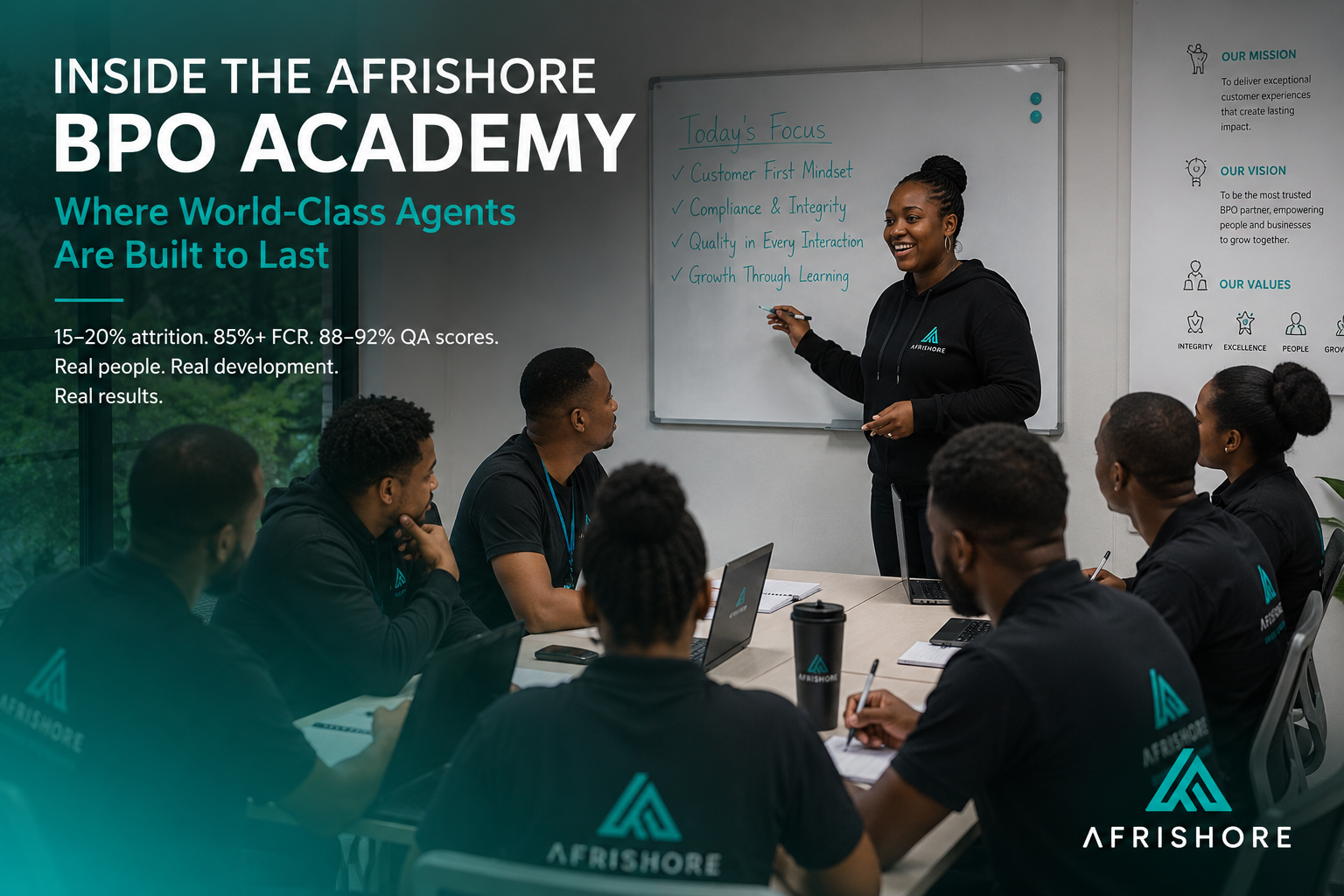
Quick Answer: The Afrishore BPO Academy is Afrishore BPO’s internal learning and development engine, covering four onboarding phases (culture, compliance, operational readiness, nesting), a four-level leadership career pathway, and the GCEO Mentorship Programme. It has trained 2,700+ employees across South Africa, the USA, and the UK – and produces 15–20% annual attrition versus 28–45% in the Philippines (CCAP) and 20–28% in India (ITeS average, NASSCOM). Academy-trained agents achieve 85%+ first-call resolution rates, 88–92% average QA scores, and 80–85% team continuity at 12 months – making the Academy the primary driver of Afrishore’s quality and retention advantage over competing offshore destinations.
The BPO industry’s attrition problem is well-documented. The Philippines’ contact centre sector ran 45% total attrition in 2022, declining to 28% in H1 2023 (CCAP). India’s ITeS sector averaged 20–28% attrition in the most recent benchmarking cycle (Mercer 2024/NASSCOM HR Benchmark 2024), though contact-centre-specific rates within India trend higher. In a 100-seat contact centre running 35–45% attrition, that means replacing 35–45 people every year – recruiting, screening, onboarding, and training them to the point where they can handle a customer call without supervision. The SHRM estimates that replacing an employee costs 50–200% of their annual salary – for a contact centre agent, that typically means USD 10,000–20,000 per exit once recruitment, onboarding, and lost productivity during ramp-up are included. Multiply that across a high-attrition team, and training becomes an expense that restarts from zero every 12–18 months.
| Metric | Afrishore (South Africa) | India BPO | Philippines BPO |
| Annual attrition | 15–20% | 20–28% (ITeS; contact-centre higher) | 28–45% |
| Team continuity at 12 months | 80–85% | 72–80% | 55–72% |
| Avg QA scores (Academy-trained) | 88–92% | Varies widely | Varies widely |
| First-call resolution rate | 85%+ | 70–79% (good range, SQM 2024) | 70–79% (good range, SQM 2024) |
| Cost per agent replacement | Lower (lower attrition × lower total) | 50–200% of annual salary (SHRM) | 50–200% of annual salary (SHRM) |
| Structured development programme | Yes – 3-tier Academy | Variable by provider | Variable by provider |
Sources: BPESA, CCAP / Philippine Daily Inquirer 2024, SQM Group 2024, SHRM
At Afrishore, attrition runs 15–20% annually. That gap – 20–45 percentage points below the offshore industry average – is not an accident. It is the output of the Afrishore BPO Academy: a deliberate investment in agent development that has operated continuously for 20 years and is embedded in how we recruit, onboard, train, and promote people.
This article explains how the Academy works, why the investment compounds over time, and what it means for enterprises who choose to partner with us.
Why Does Training Culture Determine BPO Retention – Not the Other Way Around?
Contact centre workers in the Philippines ranked “better growth opportunities” as the #2 reason for leaving (CCAP 2024, 68.5%) – and 94% of employees globally say they’d stay longer if their employer invested in their development (Gallup). Training culture determines retention because it creates the development trajectory that gives agents a reason to stay; without it, leaving is the rational choice.
The conventional framing of BPO training is reactive: agents leave, so you train new ones. The Afrishore framing is structural: agents stay because training gives them a reason to.
The LinkedIn 2024 Workplace Learning Report – corroborated by Chanty’s aggregation of training studies – found that companies with a strong learning culture retain staff at 57% higher rates than those with weak learning investment, with 23% higher internal mobility and stronger management pipelines. And 94% of employees say they would stay longer at a company if it invested in their career development (Gallup). In contact centre markets, the data is equally stark: when the Philippine CCAP surveyed why agents left, “better growth opportunities” ranked #2 at 68.5% – nearly as influential as pay. When there is no visible development trajectory, leaving is rational.
The Academy creates a visible trajectory. Agents who join Afrishore as junior agents have a structured path to specialist, team leader, quality analyst, supervisor, and operations management roles. The path is not informal or implied – it is documented, measured, and tied to specific Academy milestones. Knowing what the next level looks like, and knowing that reaching it depends on demonstrable skill rather than tenure or politics, changes the retention dynamic fundamentally.
Related reading: The compliance culture that Senzo Mkhize (Credico SA) described as a “masterclass in organisational culture” on his site visit is built through the same developmental architecture.
How Is the Afrishore BPO Academy Structured?
The Academy runs across four onboarding phases, a four-level leadership career pathway, and the GCEO Mentorship Programme – all on a single digital platform. The design choice matters: compliance comes before client product. Values come before systems training. Character before capability.
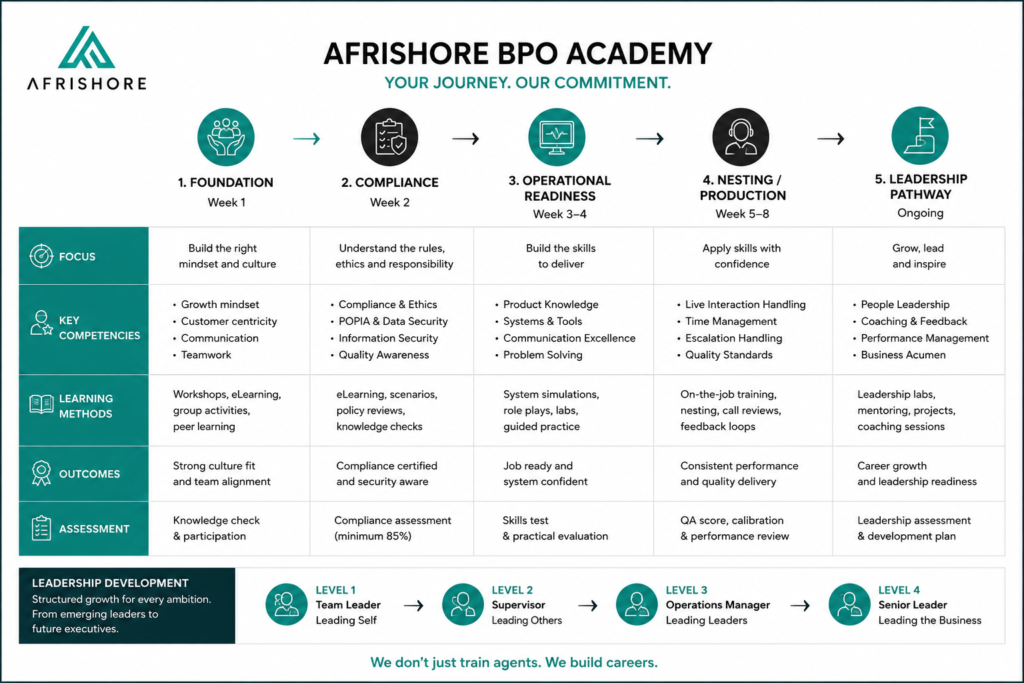
Afrishore Academy has trained 2,700+ employees across South Africa, the USA, and the UK. The sequencing is deliberate.
Onboarding doesn’t start with the client. It starts with culture. New employees cover culture induction, values, and HR policies before they touch a product manual. The logic: compliance behaviours and professional standards need to be established before product knowledge builds on top of them. An agent who understands why they’re following a HIPAA protocol is fundamentally different from an agent who knows the rule but not the reason.
Compliance training is built in, not bolted on. Before moving to operational readiness, every employee completes compliance modules relevant to the markets they’ll serve – US, UK, and South African regulatory environments, covering privacy, data protection, financial services, healthcare, and debt collection. These aren’t induction-day checkboxes. They’re the framework through which the rest of the training is interpreted.
Nesting protects the transition. The final onboarding phase is a structured nesting programme – team leaders support agents through the first live client interactions before moving them to independent production status. It is the highest-risk point in any BPO programme. Afrishore treats it deliberately rather than as an administrative formality.
The leadership pathway is visible from day one. Every agent can see a defined route from their current role through four specific levels – Team Leader, Junior Contact Centre Manager, Contact Centre Manager, Operations Manager – each with named curricula, not vague competency frameworks. When the path is real and documented, staying to walk it is rational.
GCEO Mentorship Programme
The Academy’s most distinctive element is not the onboarding programme. It is the GCEO Mentorship Programme.
A select cohort of employees – drawn from all levels of the business, not just management – is given direct access to Afrishore’s Group Chief Executive Officer for a structured six-month journey covering purpose, leadership, goal setting, accountability, and personal growth. Every session is personally facilitated by the Group CEO. The programme is cohort-based: participants develop alongside peers, building relationships and accountability that outlast the formal programme itself.
The outcome is not a certificate. It is clarity – about what the participant stands for, what they are building toward, and what the business will invest in to help them get there.
For clients, the implication is indirect but real: when the people managing your programme have been developed by their own organisation rather than poached from a competitor, their relationship with Afrishore is different. They stay. They compound. They coach the next cohort the same way.
What Results Does the Afrishore Academy Produce for Enterprise Clients?
Academy-trained agents achieve first-call resolution rates above 85% (vs 72–78% offshore industry benchmark), average QA scores of 88–92%, and customer satisfaction ratings of 4.2–4.6 out of 5 – with Specialist track graduates scoring an average of 7 points higher on QA assessments than new Foundation agents.
The Academy’s output is not a certificate. It is a measurable difference in the quality of customer interactions.
First-Call Resolution (FCR): Afrishore programmes consistently achieve FCR rates above 85% across verticals. The industry benchmark sits at 70–79% for a “good” FCR rating, with 80%+ classified as world-class and achieved by only ~5% of contact centres, according to SQM Group’s 2024 FCR benchmark study. The gap between Afrishore’s 85%+ and the industry average is not attributable to technology or script quality – it is attributable to agents who understand why they’re doing what they’re doing, and who have the authority and knowledge to resolve rather than route.
Quality Assurance scores: Average QA scores across Afrishore programmes run 88–92%, measured against client-defined QA scorecards. Agents who have progressed through the Specialist track score an average of 7 points higher than new Foundation agents – a measurable return on the training investment.
Compliance incident rates: For programmes under HIPAA, POPIA, or financial services compliance obligations, the compliance incident rate – measured as HIPAA QA scorecard failures, data handling deviations, or reportable events – is tracked per agent per month. Academy-trained agents show materially lower incident rates than agents in programmes without structured compliance training, reflecting the difference between knowing a rule and understanding why it exists.
Customer satisfaction: Net Promoter Scores and post-call satisfaction ratings for Afrishore programmes average 4.2–4.6 out of 5 across client programmes where this data is shared. Customer satisfaction in customer support is primarily a function of agent confidence and competence – both of which are direct outputs of the Academy model.
For programmes requiring demonstrated quality benchmarks before go-live, Afrishore’s Academy framework provides structured assurance: a documented training curriculum, competency assessment records, and QA score history for each agent. This is the “QA scorecard” component of the healthcare delivery model Anton’s framework specifies. Contact Afrishore to review training standards for a specific programme.
What Does 20 Years of Compounding BPO Training Look Like in Practice?
When the people responsible for training agents are experienced trainers who chose to stay, quality compounds year over year. The Academy’s senior team leaders have coached hundreds of agents, refined the curriculum through market shifts, and built the judgement that only comes from seeing the same problems recur – a form of institutional knowledge that resets at 40–60% attrition and compounds at 15–20%.
The difference between a 2-year-old BPO training programme and a 20-year-old one is not the curriculum. It is the institutional memory embedded in the people who run it.
Afrishore’s senior team leaders have been through the Academy themselves, have coached hundreds of agents, have refined the curriculum through client changes and market shifts, and have developed the judgement that comes from seeing the same problems recur across programmes and industries. That judgement is not transferable via documentation. It is present on the floor because the people who hold it have chosen to stay.
The attrition data tells this story most clearly. When the people responsible for training agents are experienced trainers who themselves chose to stay, the quality of that training compounds. When those same trainers turn over at 40–60% annually, quality resets.

Research from BPO industry bodies supports this: peer-to-peer knowledge sharing, where experienced agents coach newer colleagues rather than relying exclusively on formal training, can boost team productivity by 20–25% according to McKinsey collaboration research (via Chronus, 2026) – and improves knowledge retention significantly over classroom-only training. The Academy model builds this into the structure by graduating QA Analysts and Leadership Development Programme completers who are specifically trained to coach peers.
What Does “Academy-Grade” Training Mean for Enterprise Clients?
“Academy-grade” means faster time-to-quality on new programmes, predictable QA performance, reduced management overhead, and 80–85% team continuity at 12 months – because the Foundation Programme creates a shared competency baseline that client-specific training builds on rather than starting from zero.
When an enterprise signs a contract with Afrishore, they are not buying agents. They are buying the output of a 20-year training investment that produces:
- Agents who understand their role in the client’s customer relationship, not just their script
- Team leaders who coach rather than supervise
- QA analysts who identify systemic patterns rather than checking individual calls
- Compliance discipline that operates without an audit
- Institutional knowledge that survives normal staff turnover
The practical implications for enterprise buyers:
Faster time-to-quality: Because the Foundation Programme is a consistent baseline, agents who join a new client programme start from a higher floor than agents onboarded from scratch. Client-specific training adds to an existing competency base rather than building from zero.
Predictable QA scores: Academy-trained agents don’t have the same variance as untrained agents. Enterprise buyers can rely on consistent QA performance rather than managing agent-by-agent quality gaps.
Reduced management overhead: Team leaders who have been through the Leadership Development Programme manage their own programmes. Enterprise clients spend less time managing the BPO’s management.
Continuity: South Africa’s 15–20% attrition means 80–85% of the team is the same team after 12 months. The agent who handled your account in January is likely still the agent handling it in December. That continuity has a direct effect on customer experience – returning customers are handled by people who recognise the account, know the product history, and don’t need the backstory explained.
For a full picture of the quality architecture at Afrishore, see our overview of BPO operations in South Africa and what the BPO companies in South Africa quality spectrum looks like when benchmarked.
Key Takeaways
- BPO attrition in the Philippines runs 28–45% and India ITeS runs 20–28%. Afrishore’s runs 15–20% – a gap driven by a deliberate investment in agent development, not by market conditions alone.
- Companies with a strong learning culture retain staff at 57% higher rates (LinkedIn Workplace Learning Report, 2024). 94% of employees say they’d stay longer if their company invested in development (Gallup). 68.5% of contact centre leavers in the Philippines cite “better growth opportunities” as a reason – only slightly behind pay (CCAP, 2024).
- The Afrishore BPO Academy runs four onboarding phases (Foundation and Culture, Compliance Training, Operational Readiness, Nesting), a four-level Leadership Career Pathway (Team Leader → Junior CC Manager → CC Manager → Operations Manager), and the GCEO Mentorship Programme – supported by a single unified digital learning platform.
- Academy graduates achieve average QA scores of 88–92%, first-call resolution rates above 85% (vs industry benchmark 70–79% “good” range per SQM Group, 2024), and materially lower compliance incident rates than untrained peers.
- The Academy’s institutional value is not the curriculum – it is the 20 years of trainers, coaches, and team leaders who built their careers within it and chose to stay.
- For enterprise clients, Academy-grade training means faster time-to-quality on new programmes, predictable QA performance, reduced management overhead, and 80–85% team continuity at 12 months.
Frequently Asked Questions
What is the Afrishore BPO Academy?
The Afrishore BPO Academy is Afrishore BPO’s internal learning and development arm – not a commercial training product. It has trained 2,700+ employees across South Africa, the USA, and the UK, and runs across four onboarding phases (Foundation and Culture, Compliance Training, Operational Readiness, and Nesting/Team Integration), a four-level Leadership Career Pathway (Team Leader through Operations Manager), and the GCEO Mentorship Programme for high-potential employees. The Academy is delivered through a single unified digital learning platform and is embedded in how Afrishore recruits, onboards, develops, and retains people.
How does Afrishore’s agent training reduce attrition?
The Academy creates a visible, documented development trajectory from day one. Agents who join Afrishore have a clear path from initial onboarding through Team Leader, Junior Contact Centre Manager, Contact Centre Manager, and Operations Manager – with named course curricula at each level rather than vague competency descriptions. When the next stage is visible and reachable through genuine development, the calculation to stay changes. That path, combined with a compliance training environment that builds real expertise, means agents develop skills that compound with tenure – making Afrishore a place where staying is professionally rational.
What does Academy onboarding cover?
Onboarding runs in four phases: Foundation and Culture (values, HR, and how Afrishore works), Compliance Training (regulatory environment for US, UK, and South African contexts – privacy, data, financial services, healthcare, and debt collection), Operational Readiness (customer experience, product, systems, and QA), and Nesting (supported transition into live production). Compliance comes before product by design: values and regulatory discipline are established before client-specific content builds on top of them.
How does the Academy’s training output compare to industry benchmarks?
Academy-trained agents achieve first-call resolution rates above 85% (industry benchmark: 70–79% “good” range per SQM Group, 2024), average QA scores of 88–92% against client scorecards, and post-call customer satisfaction ratings of 4.2–4.6 out of 5. Compliance incident rates – HIPAA QA failures, data handling deviations, or reportable events – are materially lower for Academy-trained agents than for agents in programmes without structured compliance training.
How does Afrishore’s attrition rate compare to the offshore BPO industry?
Afrishore’s annual attrition rate runs 15–20% (BPESA). By comparison, the Philippines contact centre sector ran 45% total attrition in 2022, declining to 28% in H1 2023 (CCAP). India ITeS averaged 20–28% in the most recent benchmarking cycle (Mercer/NASSCOM 2024), though contact-centre-specific attrition in India trends higher within that range. BPESA benchmarks South Africa’s GBS sector at 15–25% overall, with best-in-class providers at the lower end. The practical implication for enterprise clients: at 15% annual attrition, 85% of the team is the same team 12 months into the relationship. At 50% attrition, half the team is new every year.
Can enterprise clients visit the Academy and review training standards?
Yes. Compliance site visits, including review of training curriculum documentation, Academy competency records, QA scorecard histories, and agent HIPAA or POPIA training completions, are part of Afrishore’s enterprise onboarding process. Prospective clients are encouraged to visit the Johannesburg facility, meet the team leaders who run Academy delivery, and review programme-specific training materials as part of vendor due diligence. The site visit is not a presentation – it is an open floor review. Contact Afrishore to arrange a visit.
What is the Leadership Career Pathway and what does it cover?
The Afrishore Academy Leadership Career Pathway runs through four defined levels – Team Leader, Junior Contact Centre Manager, Contact Centre Manager, and Operations Manager – each with a structured course curriculum. Team Leader development covers KPI mastery, conflict resolution, QA training, critical thinking, soft skills, and emotional intelligence. Junior Manager level adds practical leadership, people management, employee relations, and operational reporting. Contact Centre Manager adds advanced leadership, NQF5 Call Centre Management, and customer experience specialisation. Operations Manager level covers financial and KPI management, advanced people management, strategic operations, and stakeholder and client management. Each level has defined, named courses rather than loosely described competencies – making the pathway transparent to both employees and clients evaluating Afrishore’s leadership depth.
What is the GCEO Mentorship Programme?
The GCEO Mentorship Programme is the Academy’s flagship executive leadership initiative. A select cohort of employees is given direct access to Afrishore’s Group CEO through a structured six-month journey covering purpose, leadership, goal setting, accountability, and personal growth. Every session is personally facilitated by the Group CEO. The programme is cohort-based (participants develop alongside peers) and open across all seniority levels – selection is based on potential and demonstrated commitment to growth, not position. Participants leave with a personal success blueprint, defined financial and professional goals, and a set of peer relationships with the business’s future leadership.