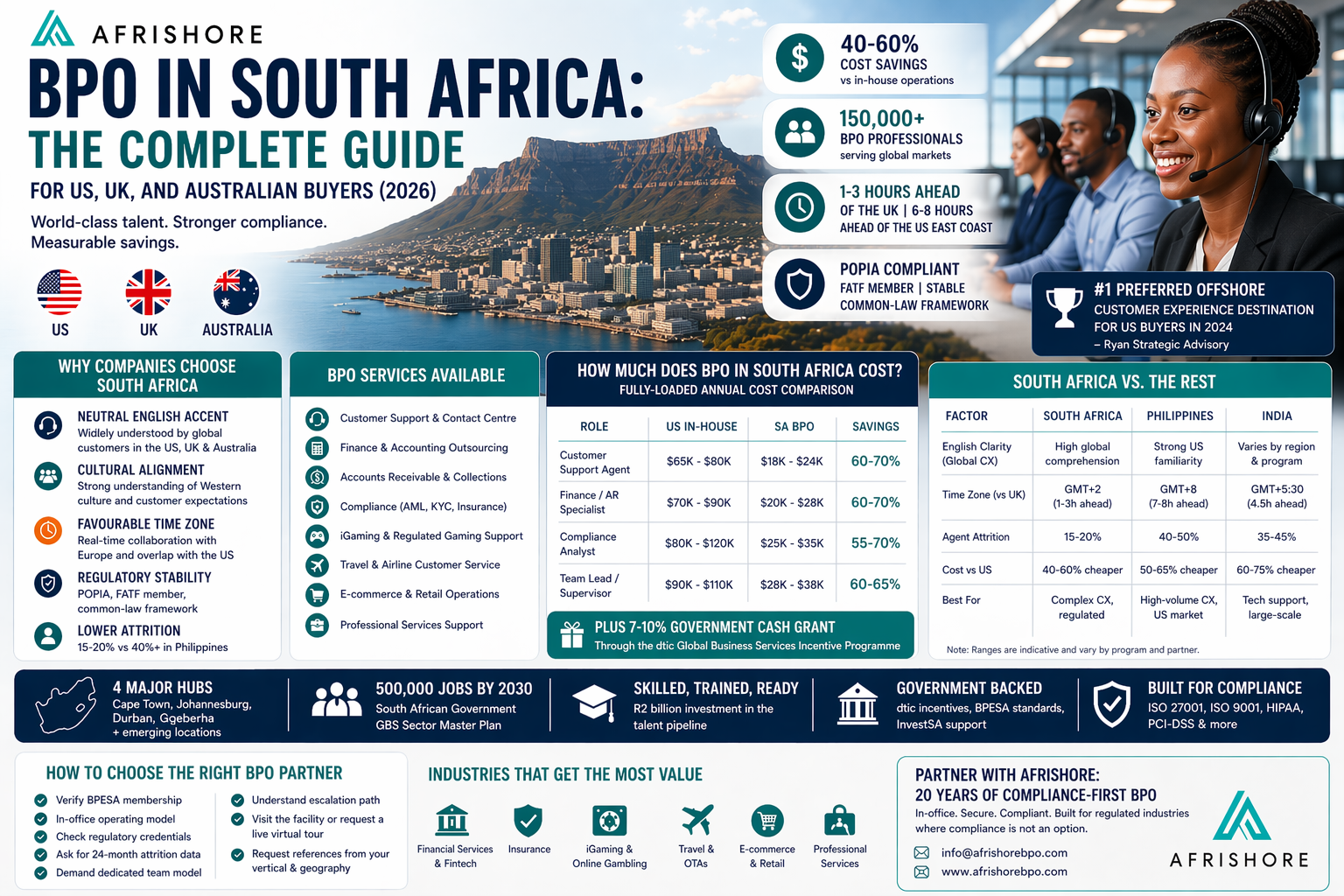
South Africa ranked as the #1 preferred offshore customer experience delivery destination for US buyers in 2024, according to Ryan Strategic Advisory’s Offshore BPO Confidence Index. The country’s BPO market was valued at USD 1.85 billion in 2023 and is projected to grow at 10.1% CAGR through 2030 (Grand View Research). This guide is for US, UK, and Australian decision-makers actively evaluating South Africa as an outsourcing destination.
What Is BPO in South Africa?
BPO in South Africa encompasses a mature global business services sector delivering customer support, back-office processing, finance and accounting, compliance services, collections, and technical support to clients in the US, UK, and Australia. The sector has grown from 65,000 international-serving roles in 2019 to 150,000 in 2024, with the South African government targeting 500,000 jobs by 2030 (BPESA/InvestSA).
The industry is anchored in four primary hubs: Cape Town (the BPO capital), Johannesburg, Durban, and Gqeberha (formerly Port Elizabeth), with emerging operations in cities like Soweto, Umlazi, and Mitchells Plain. This geographic diversity allows buyers to choose between established metro infrastructure and lower-cost satellite locations. The sector added 20,518 new jobs in 2024 alone, contributing $328 million in export revenue (BPESA).
Learn more about business process outsourcing fundamentals and how they apply to offshore delivery.
Why Do US and UK Companies Choose South Africa for BPO?
US and UK companies choose South Africa for cost savings, English proficiency, cultural alignment, favourable time zones, and regulatory stability – factors that together produce better outcomes than most traditional offshore locations.
Cost Savings: South African BPO delivers 40-60% cost reduction versus in-house US, UK, or Australian operations. A fully-loaded customer support agent in the UK costs approximately £34,659 annually, compared to £13,500-£18,000 in South Africa (BPESA National Value Proposition). These savings extend across all role types while maintaining service quality.
English Proficiency: South Africa ranked 13th globally in the 2025 EF English Proficiency Index with a score of 602 – placing it in the “Very High” proficiency band and top-ranked in Africa. The workforce speaks English with a neutral accent that is easily understood in US, UK, and Australian markets.
Cultural Alignment: South Africa shares deep cultural affinity with Western markets. The country operates under common-law legal frameworks, South Africans are familiar with American and British media and business culture, and customer interactions feel natural rather than scripted.
Time Zone Advantage: Cape Town operates on GMT+2 – 1-3 hours ahead of the UK and 6-8 hours ahead of the US East Coast. South African agents cover early US morning hours and the full European business day without night shifts. Compare this to the Philippines (GMT+8), which sits 7-8 hours behind the UK, requiring Filipino agents to work overnight for European clients.
Regulatory Stability: South Africa is a FATF member, operates under POPIA data protection legislation (comparable to GDPR), and maintains common-law frameworks familiar to US and UK legal teams. This regulatory maturity simplifies compliance handoffs for financial services, insurance, and healthcare clients.
What BPO Services Are Available in South Africa?
Customer Support and Contact Centre Services
South Africa excels in omnichannel customer support across voice, email, chat, and social media. Agents handle complex customer journeys requiring empathy and problem-solving – not just scripted responses – and the sector consistently achieves strong CSAT and NPS scores in industries like travel, insurance, and financial services.
Finance and Accounting Outsourcing
South African teams process accounts payable, accounts receivable, bookkeeping, payroll, and month-end reconciliations for US, UK, and Australian businesses. Familiarity with GAAP, IFRS, and UK accounting standards makes onboarding and training straightforward.
Accounts Receivable and Debt Collection
South Africa has developed specialised expertise in accounts receivable management outsourcing, including collections for B2B and B2C clients. Agents understand Western consumer protection laws (FDCPA in the US, FCA guidelines in the UK) and deliver empathetic, regulation-compliant collections that preserve customer relationships while recovering outstanding debt.
Compliance-Intensive Services (AML, KYC, Insurance)
Financial services and insurance companies use South Africa’s regulatory maturity for anti-money laundering (AML) reviews, know-your-customer (KYC) verification, and insurance claims outsourcing. South African processors understand UK FCA regulations and US state insurance requirements, reducing compliance risk compared to locations with less developed regulatory frameworks.
iGaming and Regulated Gaming Support
South Africa has emerged as a hub for iGaming customer support outsourcing, serving licensed operators in the UK, Malta, and US markets. Agents provide 24/7 player support, responsible gaming monitoring, bonus query resolution, and payment processing assistance while maintaining compliance with gambling commission requirements.
Travel and OTA Customer Operations
Airlines, online travel agencies, and hospitality brands rely on South Africa for travel customer support outsourcing, including GDS-trained agents who handle complex bookings, flight disruptions, and refund processing. Familiarity with Amadeus, Sabre, and Travelport systems – combined with genuine empathy during travel disruptions – makes South Africa effective for this vertical.
How Much Does BPO in South Africa Cost?
South African BPO costs range from $18,000 to $38,000 annually per full-time equivalent, depending on role complexity and seniority – delivering 60-70% savings versus US in-house operations.
| Role | US In-House (annual, fully loaded) | SA BPO (annual) | Saving |
| Customer support agent | ~$65,000-$80,000 | ~$18,000-$24,000 | ~60-70% |
| Finance / AR specialist | ~$70,000-$90,000 | ~$20,000-$28,000 | ~60-70% |
| Compliance analyst | ~$80,000-$120,000 | ~$25,000-$35,000 | ~55-70% |
| Team lead / supervisor | ~$90,000-$110,000 | ~$28,000-$38,000 | ~60-65% |
These figures represent fully-loaded costs – salary, benefits, overhead, facility expenses, and technology – not hourly labour rates. The total cost of ownership is what matters for CFO-level decisions.
Government Incentives Reduce Costs Further: The South African Department of Trade, Industry and Competition (dtic) offers a cash grant of 7-10% of operational costs for qualifying offshore BPO operations through the Global Business Services Incentive Programme. This five-year tapering grant applies to companies creating employment through offshore servicing activities, reducing South Africa’s already competitive cost structure by an additional 7-10%.
South Africa vs Philippines vs India: Which Is Right for Your Business?
| Factor | South Africa | Philippines | India |
| Primary buyer market | US, UK, AU | US, AU | US, UK |
| English proficiency | EF EPI rank 13 globally | EF EPI rank 22 | EF EPI rank 51 |
| Accent | Neutral, widely understood | Slight Filipino inflection | Strong regional accents |
| Time zone (vs UK) | GMT+2 (1-3hr ahead) | GMT+8 (7-8hr ahead) | GMT+5:30 (4.5hr ahead) |
| Agent attrition | ~15-20% annually | ~40-50% annually | ~35-45% annually |
| Cost vs US | 40-60% cheaper | 50-65% cheaper | 60-75% cheaper |
| Best for | Complex CX, regulated industries, compliance | High-volume CX, US market | Tech support, large-scale back-office |
| Geopolitical risk | Moderate (stable democracy) | Moderate (typhoon risk, infrastructure) | Low-moderate |
When South Africa Wins: Choose South Africa for regulated sectors (financial services, insurance, iGaming, healthcare), complex customer support requiring empathy and problem-solving, UK and Australian market servicing, and operations where cultural fit and accent neutrality directly affect customer satisfaction. South Africa’s 15-20% agent attrition versus the Philippines’ 40%+ means lower recruitment costs, better institutional knowledge, and more consistent service quality.
When Philippines or India May Be Preferred: The Philippines remains strong for pure cost minimisation on extremely high-volume, transactional customer service for US markets. India excels at large-scale technical support, software development, and back-office processing where engineering talent and sheer scale matter more than accent neutrality. If lowest possible labour cost is the sole criterion and you are prepared to manage higher attrition, these locations offer incremental savings of 10-15% over South Africa.
Which Industries Get the Most Value from South African BPO?
Financial Services and Fintech: Banks, payment processors, and fintech companies use South Africa for AML transaction monitoring, KYC document verification, fraud investigation, and collections. The workforce’s understanding of Western banking regulations and common-law legal frameworks reduces compliance risk.
Insurance: Property, casualty, life, and health insurers use South Africa for claims intake and processing, policy administration, and customer retention. South African agents navigate POPIA and GDPR requirements naturally, making them well-suited for UK and European insurance operations.
iGaming and Online Gambling: Licensed online casinos, sportsbooks, and poker operators require 24/7 player support with strict responsible gaming compliance. South Africa delivers agents who understand UK Gambling Commission requirements, handle player disputes with empathy, and maintain audit trails for regulatory reporting.
Travel, Airlines, and OTAs: Disruption management, complex multi-leg rebooking, and empathetic customer recovery are core South African strengths. Agents trained on Amadeus and Sabre handle weather disruptions, cancellations, and refunds while preserving brand loyalty during high-stress interactions.
E-commerce and Retail: Returns processing, order management, loyalty programme administration, and omnichannel support benefit from South Africa’s customer-first culture and familiarity with Western consumer expectations around delivery, returns, and service recovery.
Professional Services: Law firms, accounting practices, and consultancies outsource legal intake, document review, client onboarding, and administrative support. Common-law familiarity and professional communication style make South Africa effective for white-collar service industries.
How to Choose a BPO Provider in South Africa
Selecting the right South African BPO partner requires specific due diligence beyond standard RFP processes. Use this checklist to separate credible operators from marketing-heavy providers:
- Verify BPESA Membership: Business Process Enabling South Africa (BPESA) is the national industry body. Membership signals baseline quality standards and ethical practices. Non-members warrant additional scrutiny.
- Confirm In-Office Operating Model: Ask explicitly whether the provider operates from secured office facilities or uses work-from-home models. For regulated industries requiring data security, only accept providers with 24/7 secured facilities, biometric access control, and no work-from-home arrangements.
- Check Regulatory Credentials for Your Vertical: Request compliance documentation relevant to your industry – ISO 27001 (information security), ISO 9001 (quality management), PCI-DSS (payment handling), HIPAA (US healthcare), POPIA certification, or gambling licences for iGaming clients. Ask for the most recent audit date on each.
- Ask for 24-Month Attrition Data: The SA BPO average is 15-20% annual attrition. Providers who cannot or will not share specific attrition data for the past 24 months are concealing a problem. Request voluntary attrition separately from involuntary terminations.
- Demand Dedicated Team Model, Not Shared Pool: Insist on dedicated teams assigned exclusively to your account. Shared pool models dilute quality, reduce accountability, and create information security risks.
- Understand the Escalation Path: Ask who handles compliance questions, legal queries, and regulatory escalations. Best-in-class providers have in-house compliance officers and legal counsel. Providers who route these externally introduce delay and dilute accountability.
- Visit the Facility or Request a Live Virtual Tour: Nothing replaces physical inspection. If in-person visits are not feasible, request a live virtual tour – not a pre-recorded marketing video. You should see production floors, security protocols, and technology infrastructure in real time.
- Request References from Your Vertical and Geography: Demand at least three client references from your specific industry vertical (not “financial services” generically – ask for insurance if you are in insurance) serving your target geography. Speak directly with operations managers, not account executives.
For a vetted list of providers that meet these standards, review our guide to top BPO companies in South Africa.
What Is South Africa’s Government Doing to Support BPO Growth?
South Africa has made BPO and global business services a national economic priority, backed by financial incentives, skills development programmes, and infrastructure investment – reducing country risk for foreign buyers.
BPESA (Industry Body): BPESA sets quality standards, coordinates training initiatives, and provides buyer confidence through membership vetting. Its quarterly job creation reports publish transparent sector performance data – unusual transparency for an emerging BPO market.
dtic BPO Incentive Programme: The Department of Trade, Industry and Competition offers a five-year operational expenditure cash grant of 7-10% of qualifying costs for offshore BPO operations. The programme specifically targets youth employment (ages 18-34) and impact sourcing from marginalised communities, aligning commercial incentives with social development.
GBS Sector Master Plan: The government’s formal GBS Sector Master Plan targets 500,000 jobs by 2030, up from 150,000 in 2024. This includes R2 billion in training pipeline investment through the Monyetla Work Readiness Programme, which pre-trains candidates for BPO roles – reducing onboarding time and cost for employers.
InvestSA Support: InvestSA, the government’s investment promotion agency, provides dedicated support for foreign companies establishing BPO operations: site selection assistance, regulatory guidance, and introductions to skills development partners. This reduces market entry friction compared to countries where foreign investors navigate bureaucracy without support.
South Africa’s formal, funded commitment to BPO sector growth – backed by financial incentives and a ten-year Master Plan – signals long-term stability and reduces the risk that policy changes will disrupt established operations.
FAQ – BPO in South Africa
Q1: What is BPO in South Africa?
BPO in South Africa refers to the country’s global business services sector, which provides customer support, back-office processing, finance and accounting, compliance services, and technical support to US, UK, and Australian clients. The sector employs 150,000 people serving international markets, concentrated in Cape Town, Johannesburg, Durban, and Gqeberha. South African BPO excels in regulated industries requiring empathy, cultural alignment, and compliance expertise.
Q2: Why is South Africa good for BPO?
South Africa offers neutral English accents, deep cultural alignment with US, UK, and Australian markets, 40-60% cost savings versus in-house operations, favourable time zones for Western markets, and regulatory maturity under POPIA and FATF frameworks. The sector maintains 15-20% agent attrition – less than half the Philippines’ 40%+ rate – resulting in better service consistency and lower recruitment costs. Government incentives reduce operational costs by an additional 7-10%.
Q3: How much does BPO in South Africa cost?
South African BPO costs $18,000-$24,000 annually per customer support agent, $20,000-$28,000 for finance specialists, $25,000-$35,000 for compliance analysts, and $28,000-$38,000 for team leaders on a fully-loaded basis. These figures include salary, benefits, overhead, facility costs, and technology – delivering 60-70% savings versus US in-house operations and 55-65% savings versus UK rates.
Q4: What BPO services are available in South Africa?
South Africa delivers customer support and contact centre services, finance and accounting outsourcing, accounts receivable management and collections, AML/KYC and compliance processing, insurance claims handling, iGaming player support, travel and airline customer service, e-commerce operations, and professional services support. The workforce excels in complex, empathy-driven interactions requiring regulatory knowledge and cultural understanding.
Q5: Is South Africa better than the Philippines for BPO?
South Africa is better for UK and Australian markets, regulated industries, complex customer support, and operations where accent neutrality and cultural fit directly affect satisfaction scores. South Africa’s 15-20% attrition versus the Philippines’ 40%+ delivers better consistency and lower retraining costs. The Philippines offers 10-15% lower labour costs and remains strong for high-volume, transactional US market customer service. Choose based on your quality requirements, target market, and industry vertical rather than cost alone.
Q6: What languages do South African BPO agents speak?
South African BPO agents speak English as their primary business language, with neutral accents ranked 13th globally in the 2025 EF English Proficiency Index. Many agents also speak Afrikaans, isiZulu, isiXhosa, and other indigenous languages. The sector primarily serves English-language markets (US, UK, Australia, Canada) rather than multilingual European or Asian markets where the Philippines or India may offer broader language coverage.
Q7: Is outsourcing to South Africa safe and compliant?
Yes, when working with properly certified providers. South Africa operates under POPIA data protection legislation (comparable to GDPR), is a FATF member for AML compliance, and maintains common-law legal frameworks aligned with US, UK, and Australian systems. Verify provider certifications including ISO 27001 (information security), PCI DSS (payment card handling), and any industry-specific licences relevant to your vertical. Insist on in-office operating models with biometric access control for regulated industries.
Q8: How do I find a reliable BPO company in South Africa?
Start by verifying BPESA membership, then check regulatory certifications relevant to your industry. Request 24-month attrition data, client references from your specific vertical and target geography, and conduct facility tours – virtual or in-person. Demand dedicated teams rather than shared pools, and confirm in-house compliance and legal support. Evaluate at least three providers before contracting. Our guide to vetted providers is available at BPO companies in South Africa.
Partner with Afrishore: 20 Years of Compliance-First BPO
Afrishore BPO delivers customer support and back-office operations for US, UK, and Australian clients in regulated verticals – insurance claims processing, accounts receivable management, iGaming player support, and travel customer service. Operations run from secured, in-office facilities in Cape Town and Johannesburg, certified to ISO 27001, ISO 9001, HIPAA, and PCI-DSS, with dedicated teams assigned exclusively to each client account.
Our agent attrition runs consistently below the South African sector average, meaning your team retains institutional knowledge and delivers consistent service quality year over year. With 20+ years serving compliance-sensitive industries and in-house legal counsel across all engagements, we are built for operations where a compliance failure is not an option.
Contact Afrishore BPO to discuss your specific outsourcing requirements.